Store
Age-Appropriate Strength Exercises for Young Athletes
Age-appropriate strength exercises for young athletes should begin with bodyweight movements, close supervision, and a focus on balance, coordination, and confidence rather than heavy loads or maximum performance.
How do you know whether a young athlete is ready for strength exercises?
A young athlete is ready for basic strength practice when they can listen, follow simple instructions, move with reasonable control, and participate willingly. Readiness depends more on attention, interest, and movement quality than on reaching a strict age cutoff.
What parents should look for before training
Parents should look for a child who can copy a demonstrated movement, pause when asked, and stay engaged for a short activity. Start with enjoyable movement practice, simple bodyweight exercises, and supervision rather than heavy lifting or competition. If your child has pain, an injury, or a health condition, discuss the plan with a qualified youth coach and an appropriate healthcare professional before training.
Why the goal should be movement skill, not maximum weight
The first goal should be learning how to bend, brace, push, pull, land, and balance with control. Maximum weight adds pressure that young athletes do not need while they are still learning basic patterns. A successful session leaves a child feeling capable and curious, with technique that remains steady from the first repetition to the last.
Which bodyweight exercises teach young athletes the right movement patterns?
Bodyweight exercises teach control without requiring a child to manage equipment that may be too heavy or complex. We recommend brief, supervised practice and stopping a set when posture changes, balance breaks down, or the child loses interest.
- Squat to a target: Place a sturdy target behind the child and ask them to reach their hips back until they lightly touch it. Keep the chest comfortable, knees pointing in the same direction as the toes, and use a higher target or partial squat if needed.
- Step-back lunge with support: Let the child hold a wall or chair, step one foot back, bend both knees slightly, and return to standing. A smaller step or a split-stance hold is an easier variation.
- Bear crawl over a short distance: Start on hands and knees, lift the knees slightly, and take slow steps forward. Keep the distance short and return to hands-and-knees crawling if the back begins to sway.
- Incline push-up: Use a stable wall, bench, or raised surface. Keep the body in one long line and bend the elbows under control; a wall push-up is the easiest option.
- Brief plank hold: Begin on hands and knees or with hands on an improved surface, then hold a straight, comfortable body position for a few seconds. Lower the knees or shorten the hold when the child cannot keep the trunk steady.
Lower-body control through squats and lunges
Squats and reverse lunges build lower-body control by teaching children to lower and rise while keeping their feet connected to the floor. Use a target, wall, or adult hand for support, and cue “hips back” and “quiet feet.” Keep the range of motion small when balance is developing, because a controlled partial movement is more useful than a deep repetition with collapsing posture.
Core and upper-body control through crawling, planks, and modified push-ups
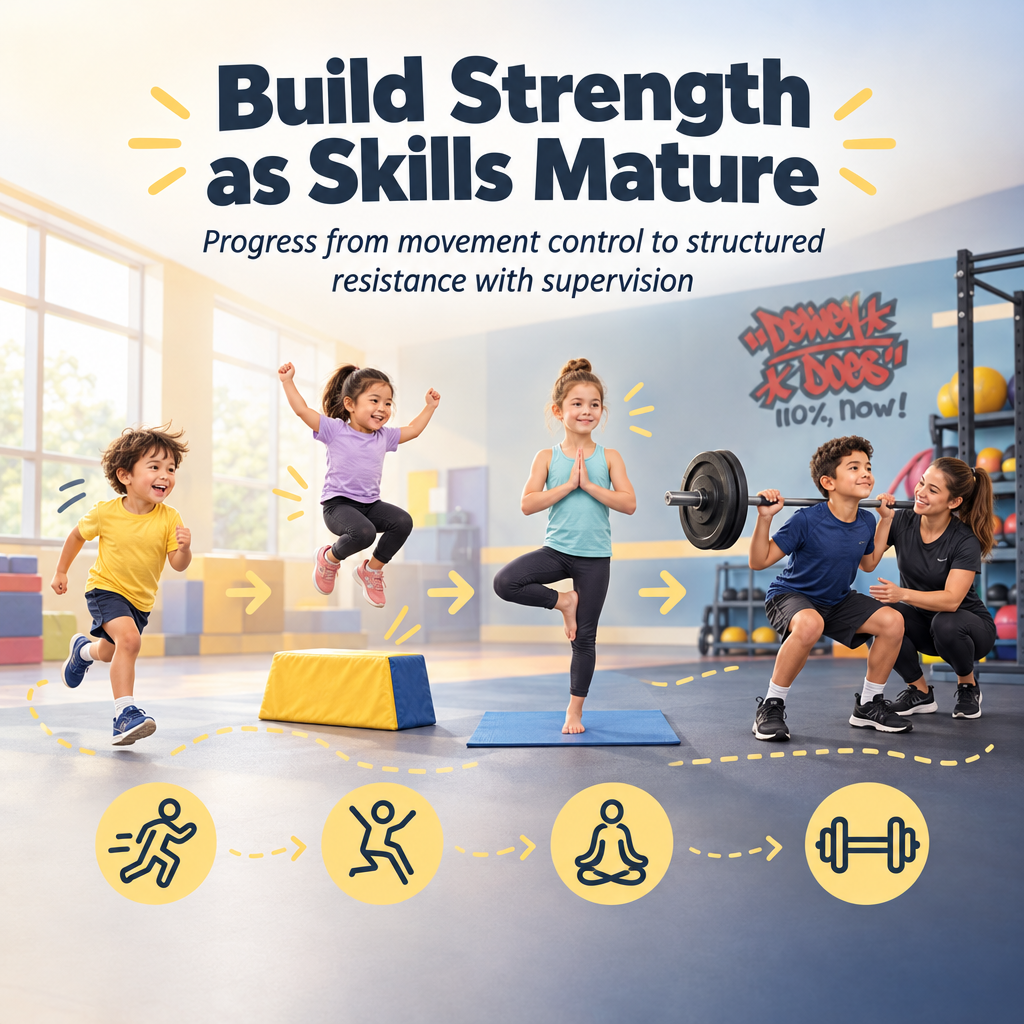
Strength exercises should become more structured as a young athlete gains attention, experience, and reliable form, but age ranges are guides rather than automatic prescriptions. Sport demands, growth, fatigue, training history, and enjoyment should shape the plan.
Younger children: play, balance, and movement variety
Younger children usually benefit most from games, crawling, jumping and landing practice, balance challenges, and light obstacle courses. Keep activities short and playful, such as hopping between markers, carrying a light object, or moving like different animals. Variety helps children practice many skills without turning exercise into repetitive work or a test of strength.
Older youth: technique, consistency, and gradual progression
Preteens can practice squats, lunges, push-up variations, planks, and controlled jumping more consistently while continuing to focus on technique. Teens with reliable form may progress through one change at a time: a few additional repetitions, a harder variation, light resistance, or more structured sets. A coach should review the change before adding another.
What makes a youth strength session safe, effective, and enjoyable?
A safe youth strength session includes active play and mobility, skill-focused exercises, a short cool-down, hydration, and a positive closing activity. Several minutes of easy movement can prepare the child, followed by a small number of controlled exercises and an enjoyable game or stretch.
Warm-up, supervision, and technique checks
Adult supervision matters because children need someone to demonstrate easier variations and notice when technique changes. Choose a qualified coach who understands youth development and watches movement quality instead of urging children to chase heavier loads. During each exercise, check breathing, balance, alignment, and willingness to continue.
Rest, recovery, and pain signals
Rest days, varied activities, sleep, and breaks from organized training help children recover and stay engaged. Effort can feel challenging, but pain is a reason to stop the exercise rather than push through it. Parents should seek appropriate professional guidance for persistent or concerning symptoms, without trying to diagnose an injury at home.
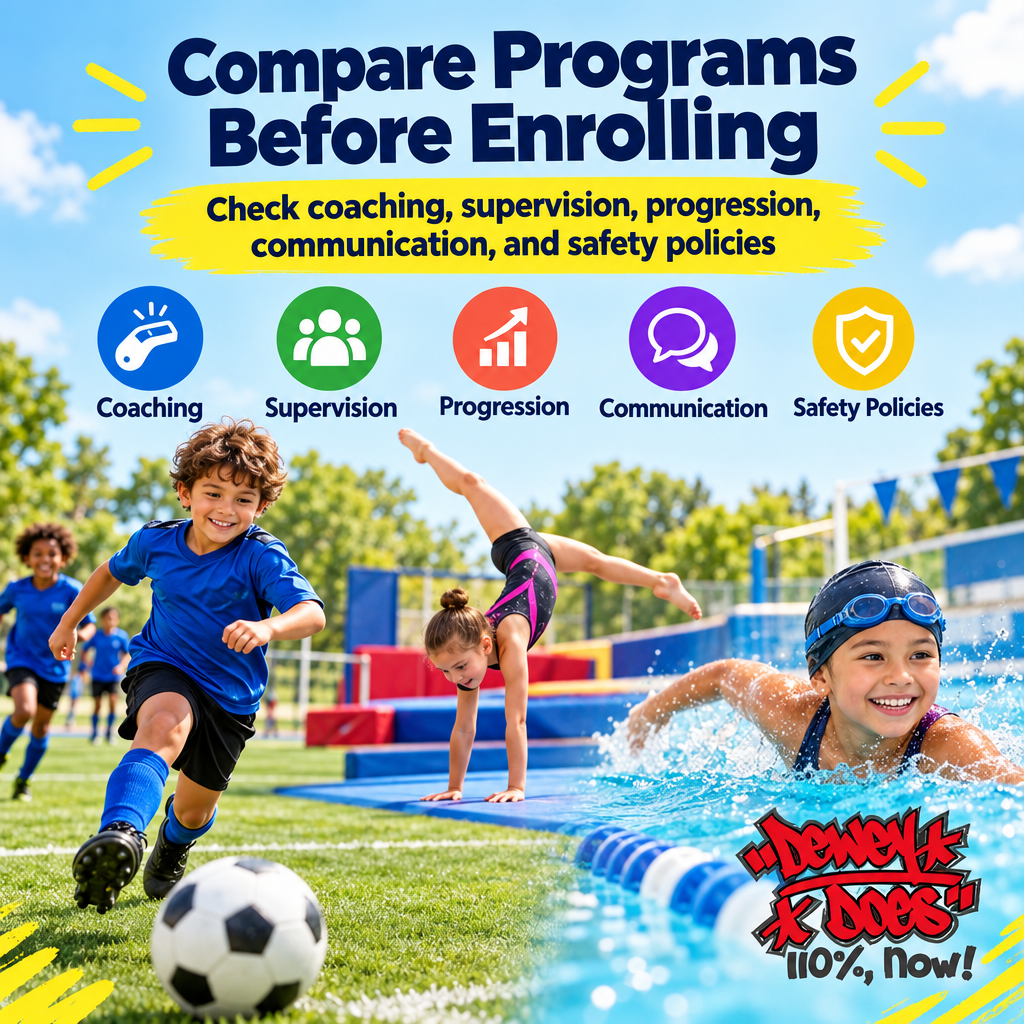
A suitable youth athletic training program explains its coaching, supervision, progression, and safety practices before enrollment. Compare programs by looking at coach qualifications and youth experience, adult-to-child supervision, age grouping, warm-up structure, equipment, parent communication, and responses to pain or fatigue.
A welcoming program adapts exercises to experience and encourages cooperation, technique, and steady participation. It should avoid public pressure, one-size-fits-all testing, and promises based only on lifting numbers. Ask whether children can use easier variations and whether the coach watches the whole group closely enough to give useful feedback.
Questions to ask about coaching and class design
Ask who leads each session, what experience they have with children, how groups are organized, and how exercises become harder. Also ask what the warm-up includes, how rest is scheduled, what equipment children use, and how staff respond when a child reports pain or unusual fatigue. Clear, specific answers show that the program has considered safety and individual differences.
A simple pre-enrollment checklist
Before enrolling, write down your child’s goals, preferred sport, prior injuries or concerns, weekly schedule, transportation needs, and available rest days. Most importantly, ask whether your child wants to participate. Family encouragement works best when it supports an informed choice rather than creating pressure to train.
How can families support strength training outside a formal program?
Families can support strength development through ordinary active time, including walks, playground circuits, backyard movement games, age-appropriate sports practice, and short bodyweight routines. These activities make balance, climbing, landing, pushing, and carrying part of normal life without turning every session into a formal workout.
Build activity into family routines
Choose activities that fit your family’s schedule, such as a walk after dinner, a weekend playground visit, or a ten-minute movement game before homework. Praise careful technique, effort, teamwork, consistency, and confidence rather than body size, rankings, or lifting numbers. Our focus at Dewey Does is helping children and families view active lifestyles as positive, welcoming, and achievable.
Use encouragement and educational materials
Children’s activewear, sports apparel, and educational materials can help make participation feel inviting, although the right choice is the one that suits the child and activity. Families can use the I Love My Dewey Does Sports Fitness Coloring Book, available for $8.99, as a family-friendly activity about healthy lifestyles and teamwork. Every purchase supports the Dewey Does Foundation’s work promoting literacy and active lifestyles.
For more ideas that connect movement with family encouragement, visit the Dewey Does Store or contact us at contact@deweydoes.com. We are happy to help families choose positive, age-appropriate resources without presenting our retail brand as a clinical training provider.
Frequently Asked Questions
What are the best strength exercises for young athletes?
The best starting exercises are controlled bodyweight movements such as squats, supported lunges, crawling, planks, and wall or incline push-ups. Choose a variation the child can perform with steady form, keep practice brief and supervised, and progress only when movement remains comfortable and enjoyable.
At what age can children start strength training?
Children can practice age-appropriate strength movements when they can follow instructions, participate willingly, and maintain basic control. Younger children generally benefit from active games and bodyweight skills, while older youth may use more structured practice and gradual resistance under qualified supervision.
Should young athletes lift weights?
Light external resistance may fit an older child or teen’s program when a qualified coach teaches technique and supervises every session. Parents should not choose load by age alone, and children should never train for maximum lifts or continue an exercise that causes pain.
How often should a child do strength exercises?
Frequency should match age, sport schedule, recovery, and the child’s energy. A coach can help set a manageable routine that includes rest days, varied activity, and breaks from demanding training. Consistency and movement quality matter more than long or exhausting sessions.